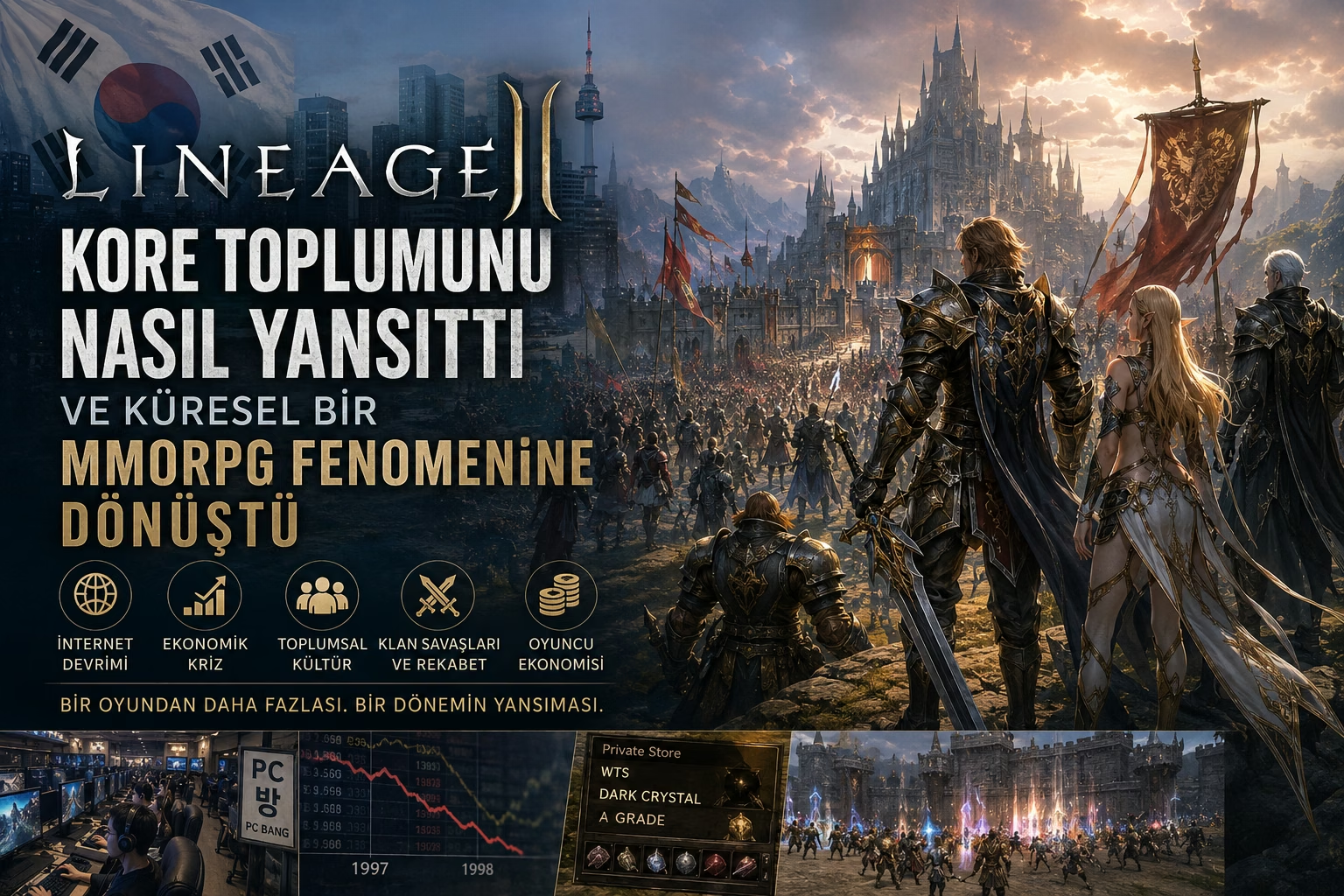
The success of Lineage and Lineage 2 was not accidental. These games emerged during a unique period in South Korea's history when rapid technological growth, economic challenges, and social changes combined to create the perfect environment for the rise of MMORPGs.
South Korea's Internet Revolution
In 1995, the South Korean government launched a nationwide initiative to modernize the country through technology. Massive investments were made in broadband internet infrastructure, and by 2005 nearly 80% of the population had access to high-speed internet. At the time, this level of connectivity surpassed many Western countries and positioned South Korea as a global leader in online technology.
As internet access expanded, interest in online entertainment grew rapidly. Gaming became one of the primary beneficiaries of this technological transformation.
The Economic Crisis That Changed the Gaming Industry
The Asian financial crisis of 1997 severely impacted South Korea's economy. Many companies collapsed, unemployment increased, and millions of people faced financial uncertainty.
Paradoxically, the crisis accelerated the growth of the gaming industry. Former employees from struggling companies formed small development teams and creative studios. At the same time, entrepreneurs opened gaming centers, known today as PC Bangs, which became a defining feature of Korean gaming culture.
In 1998, there were roughly one thousand gaming rooms across the country. Today, that number has grown to tens of thousands.
Why Korea Focused on MMORPGs
Before 1998, South Korea restricted imports of Japanese cultural products, including many popular video game consoles and titles. As a result, local developers were encouraged to build their own gaming industry rather than rely on foreign products.
Another major factor was software piracy. Like many emerging gaming markets at the time, pirated games were widely available. Traditional game sales offered little protection against illegal copying, making profitability difficult.
MMORPGs provided a solution.
Instead of selling a boxed product, developers could distribute the game client freely while charging players for access to online servers. Since the core experience depended on the server infrastructure, the game itself could not easily be pirated in the same way as single-player titles.
This business model led many Korean companies to invest heavily in MMORPG development.
The Influence of Korean Society
Korean society during the late 1990s and early 2000s emphasized community, social status, and group identity more strongly than many Western cultures.
Developers designed games that reflected these values. Rather than focusing primarily on individual character progression, Korean MMORPGs emphasized social interaction, competition, and cooperation.
Players joined clans, participated in large-scale conflicts, and built reputations within their communities. Success was often measured not only by character strength but also by social standing and recognition from other players.
This approach would become one of the defining characteristics of Lineage and later Lineage 2.
Why Lineage Became So Popular
The original Lineage was built around social interaction. NCSoft introduced castle sieges, clan warfare, and contested hunting zones that encouraged players to cooperate and compete.
Instead of spreading players across numerous locations, the game concentrated them in shared areas where conflict naturally emerged. Valuable bosses and resources were intentionally limited, forcing groups to fight over control.
The result was a living world where player relationships often mattered more than the game systems themselves.
This design philosophy resonated strongly with Korean players and later found similar success in parts of Eastern Europe and the CIS region, where social gaming experiences were also highly valued.
The Rise of the Black Market
The economic hardships of the late 1990s contributed to the emergence of in-game trading and real-money transactions.
For many players, online games became an alternative social world where achievements and status could be earned regardless of real-life circumstances. Some players sought to improve their standing by purchasing valuable items, while others discovered they could earn real income by controlling valuable farming locations and rare bosses.
According to accounts from the period, NCSoft largely tolerated these activities because they increased player engagement and encouraged long-term participation.
As long as players remained invested in the game world, subscriptions continued to generate revenue.
The Arrival of World of Warcraft
Lineage 2 initially thrived because it offered a groundbreaking 3D MMORPG experience with little direct competition.
However, the release of World of Warcraft dramatically changed the market.
Unlike Korean MMORPGs, World of Warcraft focused heavily on accessible gameplay, quest progression, and individual player experiences. The game achieved enormous success in Western markets and attracted significant attention from Korean players as well.
NCSoft began studying Blizzard's design choices and gradually incorporated similar mechanics into Lineage 2.
How Lineage 2 Evolved
During the early Chronicle updates, Lineage 2 largely followed its original vision. Clan wars, castle sieges, raid boss competition, and player conflict remained central to the experience.
As competition increased, however, the developers introduced changes aimed at attracting new players:
Faster leveling for newcomers.
More solo-friendly progression.
More predictable equipment acquisition.
Additional content designed to reduce dependence on pure randomness.
Later expansions introduced new races and classes in an attempt to revive player interest. The Kamael update, in particular, generated a noticeable increase in activity as players returned to experience the new content.
Over time, Lineage 2 adopted more features commonly found in Western MMORPGs, including instanced content and streamlined progression systems.
From Global Ambitions to a Korean-Focused Game
Despite these efforts, Lineage 2 continued to face strong competition from newer MMORPGs.
As a result, NCSoft increasingly focused on its domestic audience rather than competing directly in Western markets. This shift influenced the game's visual style, progression systems, and overall design philosophy.
Many of the colorful armor sets, flashy effects, and uniquely Korean design elements that appeared in later updates reflected this strategic change.
Legacy of Lineage 2
Lineage and Lineage 2 were more than successful MMORPGs. They were products of a specific moment in South Korean history, shaped by technological innovation, economic challenges, and cultural values.
The games introduced systems that would influence the MMORPG genre for years, from large-scale PvP and castle sieges to player-driven economies and social competition.
Even decades later, the discussions surrounding Lineage 2's design, community, and evolution demonstrate the lasting impact it has had on online gaming culture worldwide.