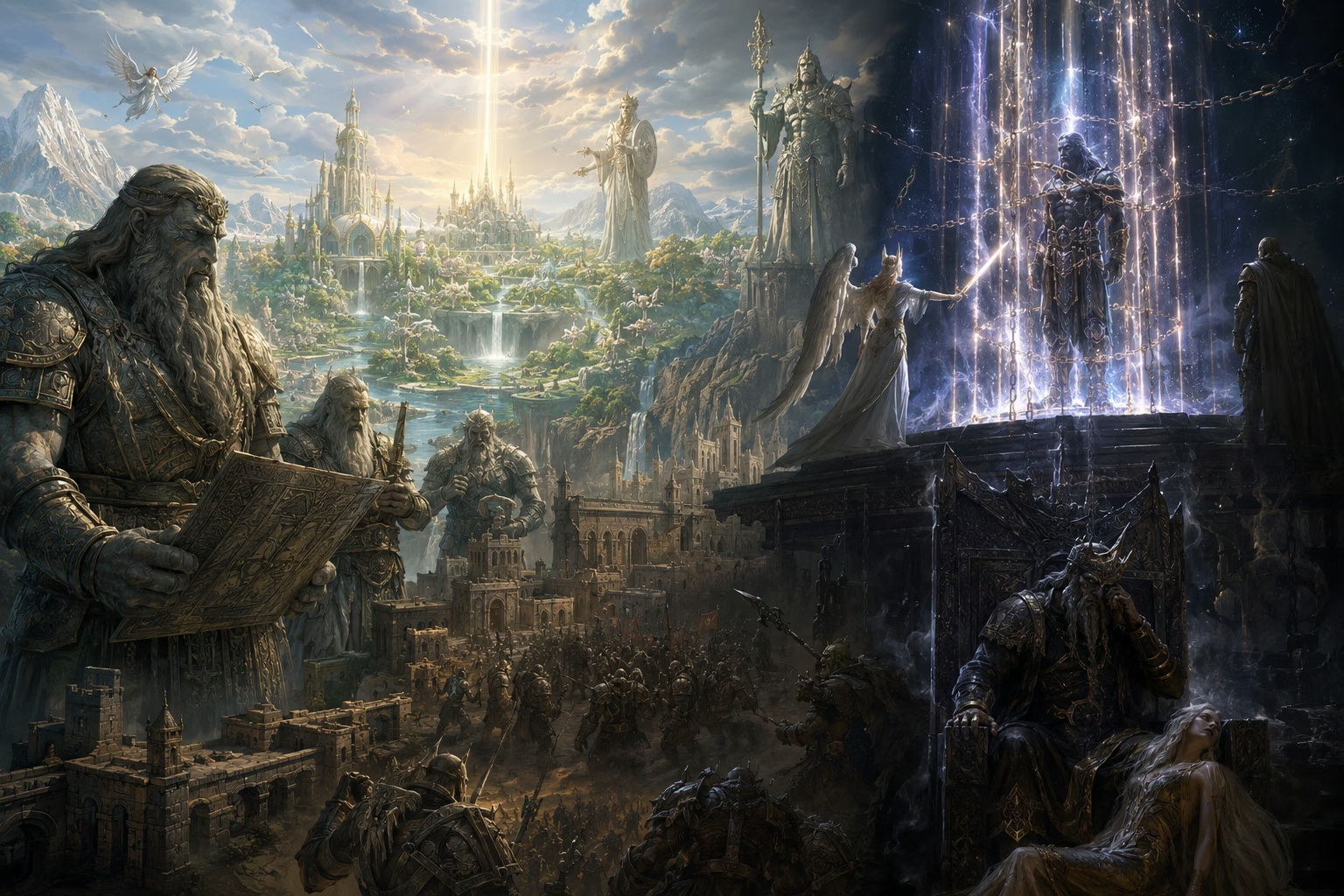
The sixth chapter of Lineage 2’s lore explores one of the most fascinating periods in the history of the world: the Age of the Upper Giants. This era witnessed the peak of magical knowledge, the creation of Magmeld, the rise and fall of legendary heroes, and the gradual collapse of the Giants’ faith in the gods.
The Golden Age of the Giants
Born from the primal sphere alongside the gods, the Giants were the most powerful civilization ever to exist. Even after the devastation caused by the Great Flood, they rebuilt their empire and restored their former glory.
Their greatest source of power was magic, a force that permeated the entire world. During the Age of Giants, magical knowledge reached its highest level. Giants such as Lakisis combined divine magic learned from Einhasad with their natural abilities, creating advanced magical techniques that spread throughout their civilization.
Other legendary figures contributed to the Giants' greatness. Saltkrieg, one of the Seven Sages, mastered the secrets of mana and taught countless Giants to wield magic. Safiros received the power of wind from Saiha and used it to dominate lesser races. Heroes like Kronvist, Nabiarop, Avelius, and Reister became legendary for their extraordinary abilities and achievements.
To preserve their knowledge, the Giants recorded the souls and powers of their greatest heroes within sacred manuscripts known as the Book of Light.
The War Against the Krofin
Despite their achievements, the Giants were often ruthless. One of the races they oppressed was the Krofin, an insect-like species led by Queen Kroshana.
Facing extinction, Kroshana sought protection from the Water Dragon Fafurion and attempted to unite their forces. The growing threat alarmed the world, and prayers were sent to Einhasad.
In response, Einhasad ordered Pa'agrio and Eva to intervene. The entrance to the Krofin Nest was sealed, and the island was hidden beneath the sea. Queen Kroshana and her brood entered a deep hibernation, ending the immediate threat.
Absolute Geometry and the Rise of Giant Civilization
The goddess Mafr granted the Giants and their Dwarven servants a powerful discipline known as Absolute Geometry. This knowledge explained the fundamental laws governing nature and led to breakthroughs in mathematics, astronomy, mechanics, navigation, economics, and engineering.
The secrets of Absolute Geometry were recorded on sacred tablets written in the language of the Giants. Only selected Dwarven elders were taught this language and entrusted with preserving the knowledge.
With their mastery of magic, science, and engineering, the Giant kingdoms flourished. Their governments were divided between two offices:
Juventus, responsible for politics and internal affairs.
Ofrentus, responsible for military leadership and diplomacy.
During this period, the original Great Olympic Games were established, centuries before their eventual revival in later ages.
Magmeld and the Garden of Genesis
As the greatest heroes of all races gained recognition, the gods created a paradise known as Magmeld.
Although different sources describe its location differently, Magmeld is generally portrayed as a divine realm connected to the World of Light Spirits. Einhasad envisioned it as a sanctuary where the finest creations of the material world could be preserved.
At the center of Magmeld stood the Garden of Genesis, a vast sanctuary containing rare animals and plants gathered from across the world. In its heart shone the Heavenly Ray, a divine light capable of purifying anything it touched.
The Garden served as a living archive of creation. Species that vanished elsewhere continued to survive within its borders. Even dangerous creatures from ancient times were kept there under divine supervision.
The city of Arcan was later built in Magmeld by Elves and Dwarves using Giant technology, while Einhasad's daughter Polina constructed the magnificent Temple of Orbis as a resting place for heroes.
The Exiles and the Seeds of Rebellion
Originally, Magmeld was intended only for the chosen followers of Einhasad. However, Gran Kain secretly allowed heroes of other races and faiths to enter.
Fearing the loss of control, Einhasad ordered that these outsiders be confined within the Prison of the Exiles of Darkness, a prison sealed by barriers of starlight.
While many accepted their fate, others did not.
Among them was the Giant hero Spasia, who argued that many of the imprisoned were neither villains nor criminals. Convinced that injustice had been committed, he gathered supporters and launched a rebellion against the will of the gods.
The rebels searched for a way to break the barrier and escape. Eventually, the great magician Espina created a spell known as Corrupting Darkness, powerful enough to destroy the prison's magical seal.
Octavis' Betrayal and the Fall of the Rebellion
The rebellion came to a tragic end because of one man: Octavis.
Unlike Spasia, Octavis maintained unwavering faith in the gods. Believing that Einhasad's decisions must be just, he sacrificed himself by absorbing the power of Corrupting Darkness.
His devotion earned him divine favor. The gods resurrected him, and together with Polina he destroyed the rebel stronghold in Fortuna.
The uprising was crushed. Most rebels were slain, while Spasia was imprisoned forever in the heart of the Prison of Exiles of Darkness. Bound by eternal starlight, he was left to suffer endlessly as a warning to anyone who challenged divine authority.
Octavis, rewarded for his loyalty, became the guardian of the Temple of Orbis.
The Corruption of Orbis
The victory came at a terrible price.
Corrupting Darkness poisoned everyone exposed to it, including Octavis himself. Over time, darkness spread through Orbis.
The fallen hero Fron and his followers turned against the temple, while many of the legendary heroes resting within became corrupted and transformed into monstrous beings. Orc heroes, human champions, and even elven legends succumbed to madness.
Octavis himself was eventually consumed by guilt, corruption, and immortality. Although he continued serving the gods, the noble hero he once was disappeared completely.
The Temple of Orbis became a prison of forgotten heroes and hidden horrors, while the outside world continued to believe it remained a sacred paradise.
Harnak and the Tragedy of Belis
While faith in the gods was already beginning to weaken, another tragedy shook Giant civilization.
King Harnak ruled from the magnificent city of Esagir and was married to Belis, renowned as the most beautiful Giant woman in existence.
Obsessed with protecting her beauty, Harnak became consumed by jealousy. Eventually, he imprisoned Belis inside a vast labyrinth to keep her away from others.
Gran Kain later discovered Belis and seduced her. When Harnak learned the truth, he was driven mad and killed his wife.
The act shattered him.
Overcome by grief and guilt, Harnak retreated into a palace deep underground, isolating himself from the world. According to later stories, the demon Malruk offered him a bargain: revive Shilen and seek revenge against Gran Kain in exchange for Belis' return from the underworld.
Harnak never fulfilled the bargain. He remained in isolation until his death, dying alone within his palace.
The End of the Upper Giants
The actions of the gods, the corruption of heroes, and the death of Harnak transformed Giant society forever.
The Giants began questioning the wisdom and morality of the gods. Their faith eroded as they witnessed divine jealousy, betrayal, and catastrophe repeatedly shaping the world.
Rather than seeking strength through worship, they turned toward science, research, and knowledge. Temples gradually gave way to research centers, and intellectual achievement replaced devotion as the foundation of civilization.
This marked the end of the Age of the Upper Giants and the beginning of the Age of the Lower Giants—a new era in which the Giants relied on their own intelligence rather than the gods.
The world of Lineage 2 would never be the same again.