The Physical Marketplace
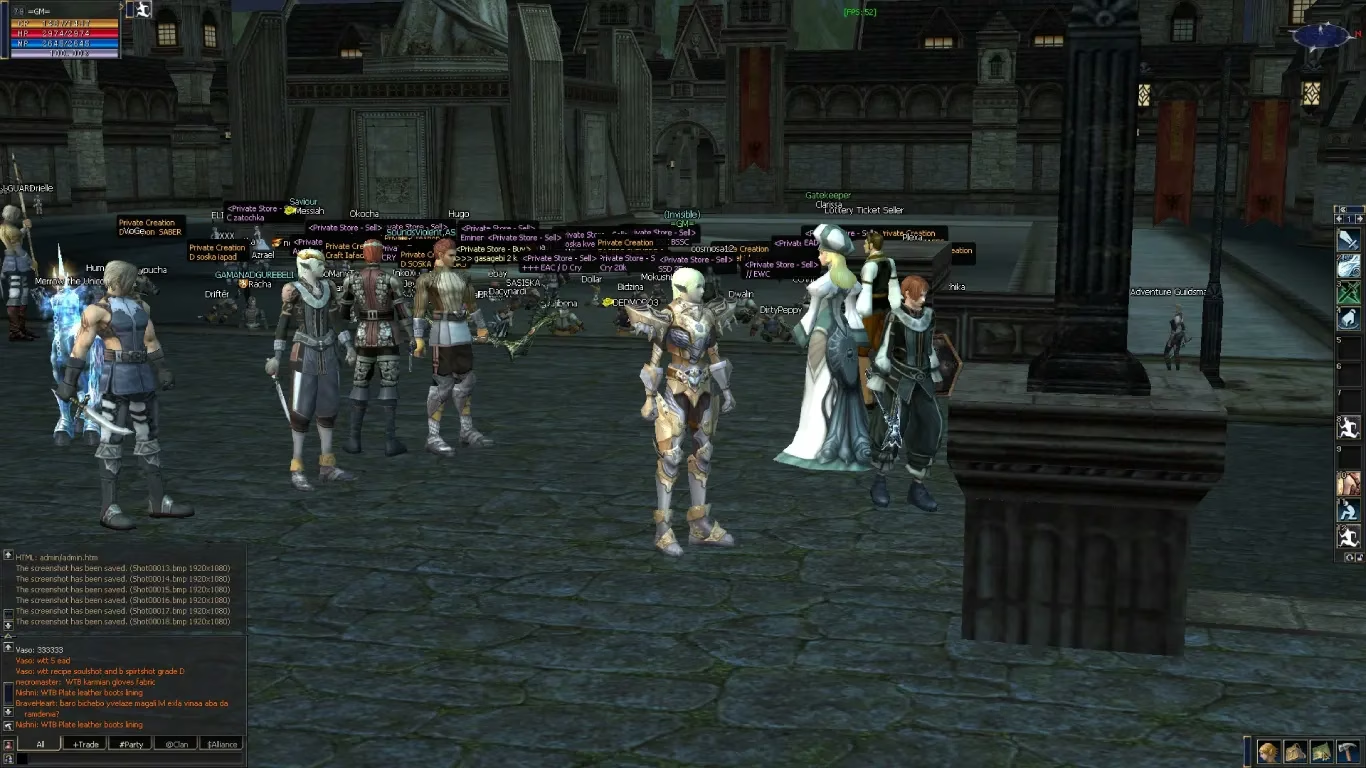
Unlike contemporary MMOs where you click an auction house NPC and browse a database, Lineage 2 required players to physically set up shop in towns. Each town had its own informal trading space—not officially defined by the developers, but naturally emerging from player behavior. You'd sit down with your goods, set your price, write a brief storefront description with limited characters, and wait for buyers to approach you.
The genius of this system revealed itself in what private servers added: offline trading. Those purple character names you'd see scattered throughout town squares? Those were players who had logged out but left their merchants running. You could build an entire trading empire across multiple characters without keeping dozens of game windows open simultaneously—a feature that, while unofficial, became essential to the game's trading culture.
When Geography Becomes Economy
Here's where things get intresting. Because trading required physical presence, the market became inherently position-based. Players couldn't just search a global database for "Ancient Adena" and find the cheapest listing across all servers. Instead, they had to navigate actual town spaces, and from this constraint, something beautiful emerged.
Communities spontaneously organized trading zones. Walk to one corner of Dion, and you'd find the crystal district—multiple merchants buying and selling various crystals, SSC (soulshots/spiritshots), and related materials. Need equipment? That's three streets over. Looking for crafting materials? There's a cluster of merchants near the eastern gate. These weren't developer-designated areas marked on the map. They were organic formations that arose because it was simply easier for everyone—buyers knew where to find what they needed, and sellers benefited from being near their competition.
The Teleportation Tax
The system's brilliance compounded when you considered inter-town economics. Teleporting between towns cost money, and this friction created genuine regional price variations. Dion might be the trading megahub, but if you were grinding near Gludin, you'd pay a premium for items there—a premium that exactly reflected the time or money cost of teleporting to Dion.
This created real opportunities for merchant players. You could buy low in Dion, teleport to a remote town, and sell higher. The price difference wasn't arbitrary—it represented actual value added through the logistics of moving goods. Players had to calculate whether the teleportation fees and taxes justified the price differential. Suddenly, you weren't just trading items; you were running supply chains.
What We Lost
Modern auction houses are undeniably more convenient. You can list an item in seconds, search across all listings instantly, and complete transactions without moving. But in optimizing for convenience, we lost something profound: the sense of place in virtual economies.
In Lineage 2, you learned the geography of commerce. You remembered that the northwest corner of Giran had the best weapon prices, that Tuesday evenings were busy in Aden's armor district, or that certain merchants always undercut each other near the fountain. The market wasn't a menu—it was a place, with its own rhythms, landmarks, and unwritten rules.
The position-based system also created accidental player interactions. You'd be browsing for equipment and overhear (in local chat) someone negotiating a bulk deal. You might strike up a conversation with a merchant while waiting for a friend. These weren't forced social features; they emerged naturally from the spatial nature of trade.
Could It Work Today?
The honest answer is probably not—at least not in mainstream MMOs. Today's players expect streamlined systems, and position-based trading would be criticized as "tedious" or "outdated." But there's something worth preserving in the concept: the idea that virtual worlds should have friction, that geography should matter, and that economic systems can create emergent gameplay.
Perhaps the lesson isn't to bring back exactly what Lineage 2 had, but to remember that optimizing away all inconvenience sometimes means optimizing away the systems that made virtual worlds feel genuinely alive. The merchants of Dion weren't just trading items—they were creating a culture, a landscape of commerce that existed nowhere in the game's code but everywhere in its world.
Sometimes the journey is the destination, even when you're just trying to sell a +3 Grade-D sword.