Understanding how item drops work in Lineage 2 is essential for efficient farming, raid participation, and maximizing rewards. While the system may seem simple on the surface, several hidden mechanics determine whether items drop and who is eligible to receive them.
This guide covers regular monster drops, raid boss loot, quest item drops, and the Spoil system as they function on classic Lineage 2 chronicles.
Regular Monster Drops
Item drops are one of the core systems of Lineage 2 and have existed since the earliest versions of the game. On the first chronicles (C1 and C2), drop calculations were based on the character who dealt the final hit to a monster.
This created an exploit where a high-level character could do most of the damage while a lower-level character delivered the killing blow. Since the lower-level character received the drop calculation, players could avoid level-based drop penalties.
Beginning with later updates, NCSoft changed the system. Instead of using the final hit, drop penalties are now calculated based on the character who dealt the highest amount of damage to the monster.
Level Difference Penalties
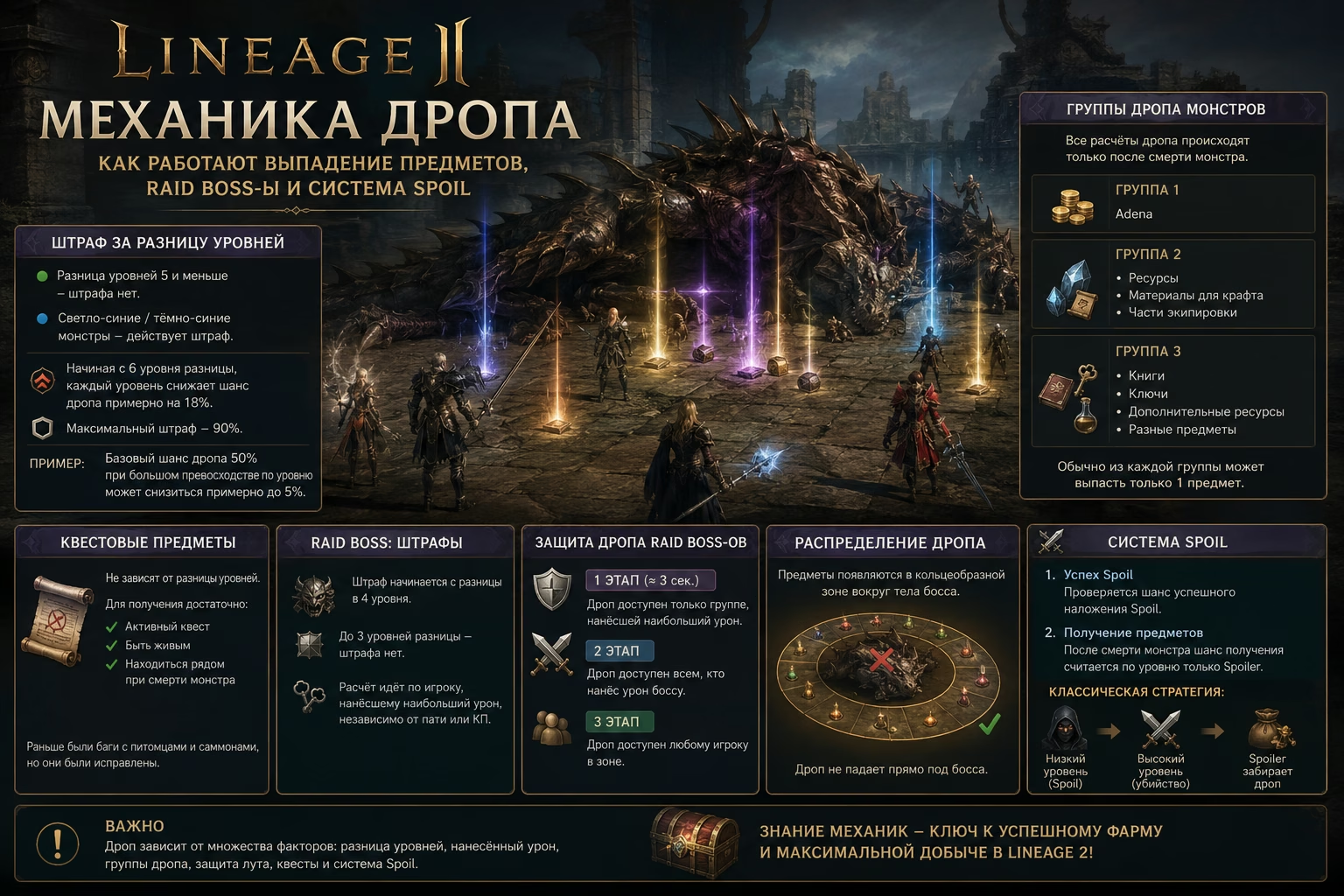
For regular monsters, there is no drop penalty if the level difference between the player and the monster is five levels or less.
A simple rule applies:
White or green monsters: no drop penalty.
Light blue or dark blue monsters: drop penalties apply.
Starting at a six-level difference, each additional level reduces drop chances by approximately 18%.
The maximum penalty is capped at 90%.
For example, if an item normally has a 50% drop chance and the player exceeds the monster's level by a large margin, the effective chance can drop to around 5%.
How the Penalty Is Applied
Before the game checks whether an item drops, it first performs a separate penalty check.
For example, if a player has an 18% penalty, the game first determines whether the drop attempt is allowed. Only after passing that check does it proceed to calculate the item's actual drop chance.
This means even items with very high drop rates can fail to appear because the penalty check occurs before the drop calculation itself.
How Drop Tables Work
Items are not generated when a monster spawns. Instead, the drop table is processed when the monster dies.
On older chronicles, monsters typically had three separate drop groups:
Group 1
Adena
Group 2
Materials
Crafting components
Equipment pieces
Group 3
Books
Keys
Additional resources
Miscellaneous items
Each group has its own drop chance, and generally only one item can be selected from each group.
As a result, a normal monster can often drop a maximum of three separate rewards.
Quest Item Drops
Quest item drops operate differently from regular item drops.
Unlike normal loot, quest drops are not affected by level difference penalties. Players can receive quest items regardless of whether they are above or below the monster's level.
Starting with later chronicles, party quest mechanics were introduced. Players no longer needed to deal damage themselves. As long as they:
Had the quest active,
Were alive,
Remained within the required range of the monster's death,
they could receive quest items.
Earlier versions of Lineage 2 contained bugs involving pets and summons. If a pet delivered the killing blow, some quest items would not be awarded correctly. These issues were eventually fixed in later updates.
Raid Boss and Epic Boss Drops
Raid boss loot functions similarly to regular monster drops, but with one important difference.
Drop penalties begin at a much smaller level gap.
For raid bosses:
No penalty within three levels.
Penalties begin at four levels above the boss.
The character who dealt the highest amount of damage determines whether a level penalty is applied to the raid boss loot.
It does not matter:
Which party they belong to.
Whether they changed parties during the fight.
Whether they are in a command channel.
The boss simply tracks total damage dealt and uses the highest contributor for the drop calculation.
Raid Boss Loot Protection
When a raid boss dies, loot is protected for a short period.
First Phase
For approximately three seconds, only the party associated with the highest damage contribution has exclusive pickup rights.
Second Phase
After the protection period expires, any player who dealt damage to the boss can pick up the loot.
Final Phase
After a longer delay, anyone nearby can collect the items.
Because raid bosses track specific party identifiers, reorganizing parties during a raid can sometimes create unexpected loot distribution issues.
For this reason, experienced groups generally avoid changing party compositions during important boss encounters.
Why Some Players Stole Early Epic Loot
One famous situation occurred during early Antharas kills on Korean servers.
Players who left their command channel shortly before the boss died were still eligible to loot because they had contributed damage. Once the short protection window expired, they could reach the dropped items before raid leaders.
After incidents like these, loot protection times were adjusted to reduce abuse.
How Raid Boss Loot Is Scattered
Many players believe raid bosses drop items randomly inside a square area.
In reality, the system is more sophisticated.
The game generates loot positions within a circular ring around the boss, creating what developers often describe as a "donut" shape:
Items do not drop directly beneath the boss.
Items appear within a defined circular area surrounding the corpse.
Older chronicles contained mathematical errors in these calculations, causing loot to appear only within part of the intended circle.
Despite this, there is effectively no limit to the amount of loot a boss can generate. Extremely large drops simply continue filling available positions around the corpse.
Items Stuck Inside Terrain
Most Lineage 2 veterans have experienced valuable items becoming trapped inside rocks, walls, or other terrain.
The server actually performs pathfinding checks before placing loot. However, due to limitations in geodata calculations, these checks occasionally fail.
This issue has existed not only on private servers but also on official versions of the game for many years.
As a result, rare and valuable items have occasionally become unreachable despite the game's attempts to prevent it.
Understanding the Spoil System
Spoil operates differently from normal item drops.
The system consists of two separate checks:
1. Spoil Success Check
First, the game determines whether the Spoil skill successfully affects the monster.
This calculation depends heavily on the level difference between the Spoiler and the target.
2. Loot Extraction Check
Once Spoil is successfully applied, the monster remains spoiled until death.
After the monster dies, the game calculates whether spoil loot can be extracted.
At this stage, only the level of the character who originally applied Spoil matters.
Common Farming Strategy
A classic farming technique involved:
Using a low-level Spoiler to apply Spoil.
Bringing a high-level damage dealer to kill monsters quickly.
Extracting spoil materials with the low-level Spoiler.
Since the extraction calculation references the Spoiler rather than the killer, players could efficiently farm valuable resources while maintaining optimal spoil rates.
High-Level Monsters and Drop Penalties
Many players wonder whether killing monsters far above their level affects drops.
The answer is no.
Just like experience gains, Lineage 2 does not impose drop penalties for fighting monsters that are significantly higher level than the player.
Penalties only apply when the player's level greatly exceeds the monster's level.
Final Thoughts
Lineage 2's drop system is far more complex than simply killing monsters and hoping for loot. Level penalties, damage contribution, drop groups, raid protection timers, quest mechanics, and Spoil calculations all play a role in determining rewards.
Understanding these systems allows players to farm more efficiently, avoid unnecessary penalties, and make better decisions during both solo grinding and large-scale raid encounters.