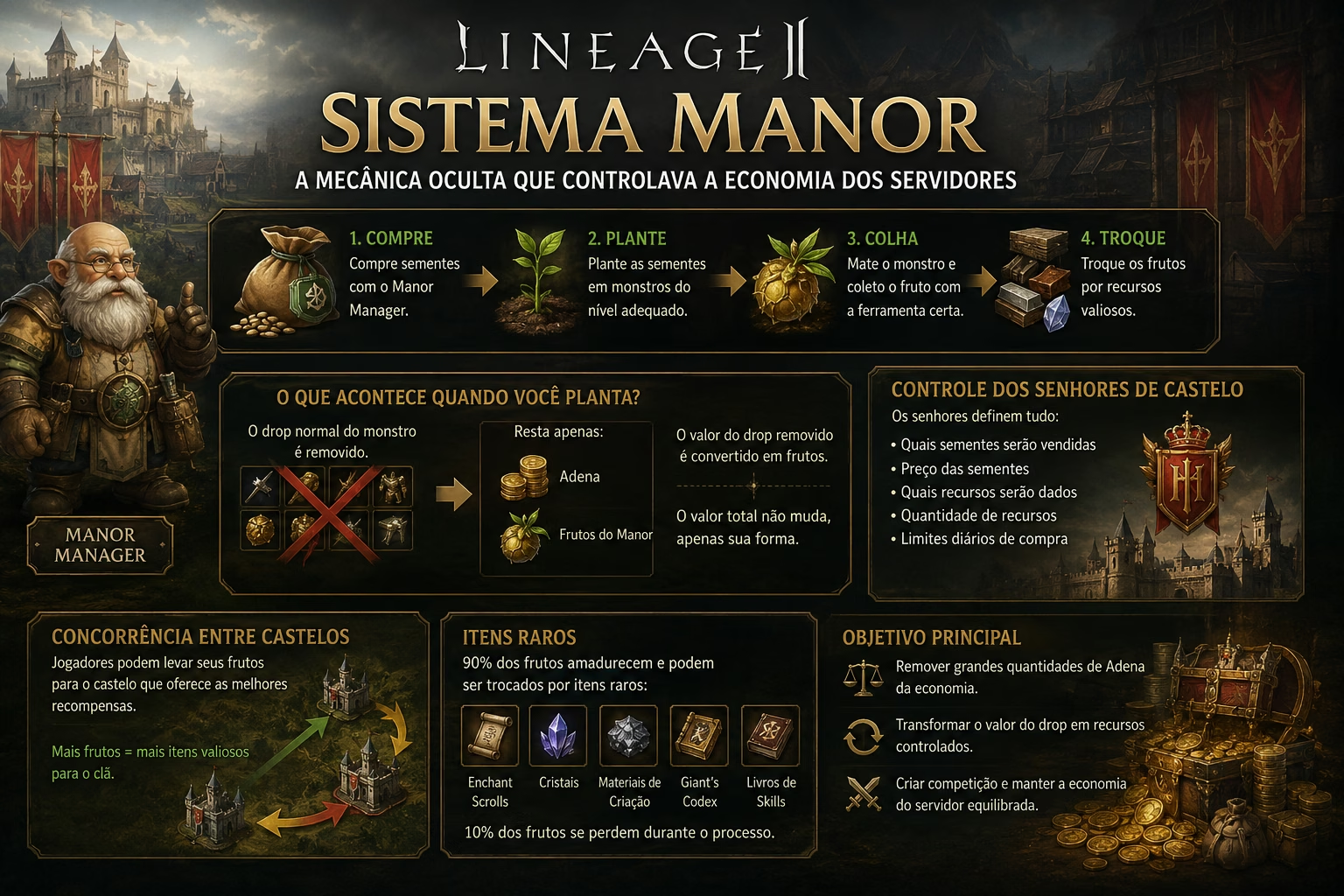
Among all the systems ever introduced in Lineage 2, few were as complex and influential as the Manor System. Alongside the Seven Signs event, Manor was one of the rare game mechanics capable of affecting an entire server's economy through the combined actions of thousands of players.
While many players viewed Manor simply as a way to obtain crafting resources, its true purpose went far beyond farming materials. Behind the scenes, it functioned as a sophisticated economic tool designed to control inflation, regulate the flow of Adena, and create competition between castle-owning clans.
What Is the Manor System?
At its most basic level, the Manor System allows players to purchase seeds from Manor Managers, plant them in monsters, harvest crops, and exchange those crops for resources.
Unlike Dwarven Spoil, Manor does not directly generate resources from monsters. Instead, players:
Purchase seeds from a Manor Manager.
Plant seeds in monsters of the appropriate level.
Harvest crops using a harvester tool after killing the monster.
Exchange harvested crops for crafting materials.
Although the process appears simple, the underlying mechanics are far more advanced.
The Real Purpose of Manor
The primary goal of the Manor System was to combat inflation.
On every active server, players continuously generated Adena by killing monsters. Over time, the amount of currency entering the game far exceeded the amount leaving it through NPC purchases. This naturally led to inflation, causing item prices to rise dramatically while making it harder for new players to compete.
NCSoft anticipated this problem years in advance. Early Manor-related files even existed during the Prelude era, though the system was not officially activated until later chronicles.
The Manor System was created to remove large amounts of Adena from circulation while simultaneously rewarding players with valuable resources and rewarding castle lords with rare items.
How Castle Lords Control the System
Each castle lord determines:
Which seeds are available for sale.
The selling price of seeds.
Which resources players receive for crops.
The quantity of resources rewarded.
Daily purchasing limits for crops.
Seeds are purchased from NPCs at a fixed base price. Castle lords then choose a final selling price within a predefined range.
Seed Price Limits
Maximum Price: 10× the base seed value.
Minimum Price: 60% of the base seed value.
This allows lords to either maximize profits or encourage greater participation from players.
However, every seed order must be paid for in advance from the castle treasury. If there is not enough Adena in the treasury during the daily update, all Manor settings are canceled.
Why Different Castles Sell Different Seeds
Not every seed is available in every territory.
Each seed can only be planted in monsters within a specific level range. If a territory lacks enough suitable monsters, that seed cannot be offered by the castle's Manor Manager.
As a result:
Low-level territories focus on beginner seeds.
High-level territories offer seeds designed for stronger monsters.
This creates regional specialization and encourages players to travel between territories.
What Happens When You Plant a Seed?
When a seed is successfully planted, something important happens:
The monster's normal item drops are removed.
The only rewards remaining are:
Adena
Manor crops
This is where the system's economic magic begins.
Most players assumed Manor simply generated resources. In reality, NCSoft designed it to convert the value of monster drops into crops.
Every monster in the game was assigned an internal value based on the average worth of its potential drops. The game then converts that value into harvested crops.
For example:
A weak monster might produce one crop worth 100 Adena.
A high-level monster could produce several crops worth thousands of Adena.
The total value remains roughly equivalent to the drops that were removed.
In other words, the loot never disappears—it changes form.
Crop Rewards and Resource Exchange
Each crop is linked to two possible resource rewards.
Castle lords choose which reward players receive and how much they will earn.
Examples include:
Animal Skin
Crafted Leather
Various crafting materials
The amount received depends on:
The crop's purchase price.
The resource's base value.
The game converts crop value into resources using hidden probability formulas. Over large numbers of exchanges, the total value of resources awarded closely matches the value represented by the crops.
This ensures the system remains balanced across the entire server economy.
Competition Between Castle Lords
One of the most interesting aspects of Manor is that castle lords compete against one another.
A lord can purchase more crops than the number of seeds sold within their own territory. This means players are free to sell crops to whichever castle offers the best rewards.
As a result, lords constantly compete by:
Offering better resource rewards.
Adjusting crop prices.
Attracting farmers from rival territories.
The more crops a lord acquires, the more rare items they can craft for their clan.
Crafting Rare Items Through Manor
After crops are collected, 90% mature into ripe crops while 10% disappear during processing.
The mature crops can then be exchanged for valuable items such as:
Enchant Scrolls
Crystals
Crafting Materials
Giant's Codex
Skill Enchant Books
The number of crops required is carefully balanced so that the total value of crafted items never exceeds the value originally removed from monster drops.
This was one of the system's most important safeguards against inflation.
Why NCSoft Later Considered Manor a Mistake
Despite its brilliant design, Manor eventually became difficult to manage.
During the Prelude and C1 eras, severe economic exploits and Adena duplication created massive inflation. By the time Manor was fully introduced in C2, many castle owners already possessed enormous wealth.
Originally, the system also lacked price restrictions, allowing lords to offer absurd rewards and flood servers with resources.
Although later updates introduced limits and safeguards, the damage to server economies had already been done.
In 2014, NCSoft officially referred to the Manor System as one of the company's biggest mistakes.
A Brilliant but Misunderstood System
Even though NCSoft later criticized Manor, it remains one of the most sophisticated economic systems ever implemented in an MMORPG.
The Manor System quietly removed millions of Adena from circulation, converted monster loot into controlled resource generation, encouraged competition between castle-owning clans, and helped stabilize server economies for years.
Unfortunately, because its mechanics were hidden behind complex formulas and server-side calculations, most players never fully understood how it worked.
Today, Manor stands as a fascinating example of ambitious MMORPG design—an intricate system that was simultaneously one of Lineage 2's greatest innovations and one of its most controversial experiments.