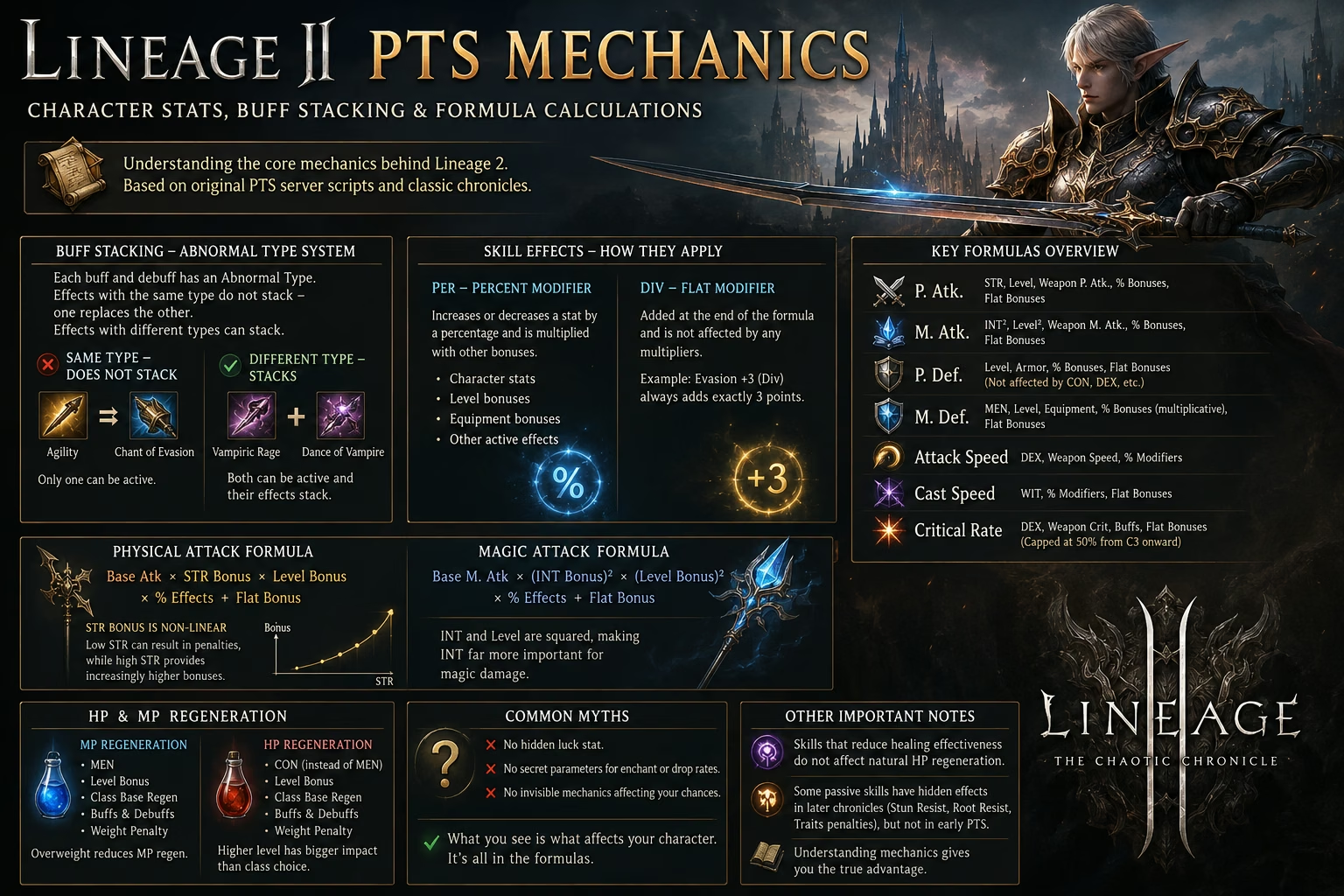
Understanding how character statistics work in Lineage 2 has always been a topic of interest among players. By examining the original PTS server scripts, it becomes possible to see exactly how buffs, debuffs, attacks, defenses, regeneration, and other core mechanics are calculated.
This article explores the underlying systems behind character stats and dispels several long-standing myths that have circulated throughout the game's history.
Understanding Buff Stacking
One of the most important concepts in Lineage 2 is the Abnormal Type system. Every buff and debuff belongs to a specific abnormal category.
When two effects share the same Abnormal Type, they do not stack. Instead, one effect replaces or overrides the other according to predefined rules such as skill level or duration.
Example: Agility and Chant of Evasion
Both skills increase evasion, but they share the same Abnormal Type. As a result, only one of them can be active at a time.
Example: Vampiric Rage and Dance of Vampire
Although both skills provide life-steal effects, they use different Abnormal Types. Because of this, they can coexist and their effects stack together.
How Skill Effects Are Applied
Most skill effects use two primary modifiers:
Percentage Modifier (Per)
This value increases or decreases a statistic by a percentage and is multiplied together with other bonuses, including:
Character stats
Level bonuses
Equipment bonuses
Other active effects
Flat Modifier (Div)
This value is simply added at the end of the calculation and is not affected by any multipliers.
For example, an evasion bonus with a Div value of +3 always adds exactly three points regardless of other modifiers.
Physical Attack Formula
Physical Attack (P. Atk.) is calculated using several factors:
Strength (STR) bonus
Level bonus
Weapon attack value
Percentage bonuses from buffs and debuffs
Flat bonuses added afterward
The general structure is:
Base Attack × STR Bonus × Level Bonus × Percentage Effects + Flat Bonus
The Importance of STR
The STR bonus is not linear. As Strength increases, the percentage gain changes at different thresholds.
Characters with low STR can even suffer penalties, while high STR values provide increasingly powerful offensive bonuses.
Historically, STR bonuses were adjusted during early Chronicle updates, significantly improving the damage output of dagger classes.
Magic Attack Formula
Magic Attack (M. Atk.) follows a similar structure but uses Intelligence (INT) instead of Strength.
Unlike Physical Attack, Magic Attack calculations involve:
INT bonus squared
Level bonus squared
Weapon magic attack
Percentage effects
Flat bonuses
As a result, Intelligence has a much stronger impact on magical damage than weapon power alone.
Physical Defense Formula
Physical Defense (P. Def.) is one of the simpler calculations.
It depends on:
Level bonus
Armor value
Percentage modifiers
Flat additions
Notably, Physical Defense on classic chronicles does not scale with CON, DEX, or any other character attribute.
Example
Tank skills often provide large flat defense bonuses. If multiple flat bonuses are active, they are simply added together.
Magic Defense Formula
Magic Defense (M. Def.) uses:
MEN bonus
Level bonus
Equipment values
Percentage modifiers
Flat additions
Percentage-based buffs such as songs and barriers multiply with each other rather than simply adding together.
This explains why stacking multiple magical defense buffs produces higher-than-expected results.
Attack Speed and Casting Speed
Attack Speed
Attack Speed depends on:
DEX bonus
Weapon attack speed
Percentage effects
Casting Speed
Casting Speed depends on:
WIT bonus
Percentage modifiers
Flat additions
Weapon speed does not directly affect casting speed calculations.
Critical Rate Mechanics
The displayed Critical Rate is calculated from:
DEX bonus
Weapon critical value
Buff modifiers
Flat additions
During early chronicles, critical chance had no hard cap, allowing players to reach extremely high values.
Beginning with Chronicle 3, Critical Rate became capped at 50%, preventing further gains beyond that threshold.
HP and MP Regeneration
Regeneration follows a structure similar to other formulas.
MP Regeneration
MP regeneration depends on:
MEN bonus
Level bonus
Base class regeneration value
Buffs and debuffs
Weight penalty
When a character becomes heavily overloaded, regeneration is reduced accordingly.
HP Regeneration
HP regeneration follows the same formula but uses CON instead of MEN.
Interestingly, examination of the original scripts suggests that many archetypes share identical regeneration values, making level progression a far more significant factor than class selection.
The Myth of Hidden Luck
A common rumor among Lineage 2 players claimed that every character possessed a hidden luck statistic determined at creation.
According to the original server scripts, no such mechanic exists.
There is no hidden parameter that influences:
Enchant success
Item drops
General luck
Character fortune
Perceived differences between characters are largely explained by confirmation bias, where players remember unusual successes while forgetting ordinary failures.
Regeneration vs. Healing Effectiveness
Another common misconception involves the distinction between regeneration and healing effectiveness.
Some skills reduce the effectiveness of healing received, while others reduce actual HP regeneration.
These are entirely separate mechanics.
For example, the Spellhowler skill Demon Wind reduces healing effectiveness but does not lower a target's natural HP regeneration. As a result, casting it on raid bosses will not decrease their regeneration rate.
Hidden Effects on Passive Skills
Later chronicles introduced additional hidden modifiers on certain passive skills.
Examples include:
Reduced stun resistance
Reduced root resistance
Additional trait-based penalties
However, these hidden effects were introduced much later than C3 and C4, becoming common only after NCSoft expanded the game's attribute and trait systems.
As a result, these penalties do not exist on classic PTS servers from the earlier chronicles.
Conclusion
The original PTS scripts reveal that many long-standing community theories about Lineage 2 are either misunderstandings or myths. Character performance is determined by a clear system of formulas involving attributes, level bonuses, equipment values, and skill effects.
Understanding how Abnormal Types work, how buffs stack, and how core formulas are calculated provides players with a much deeper understanding of the mechanics behind classic Lineage 2.