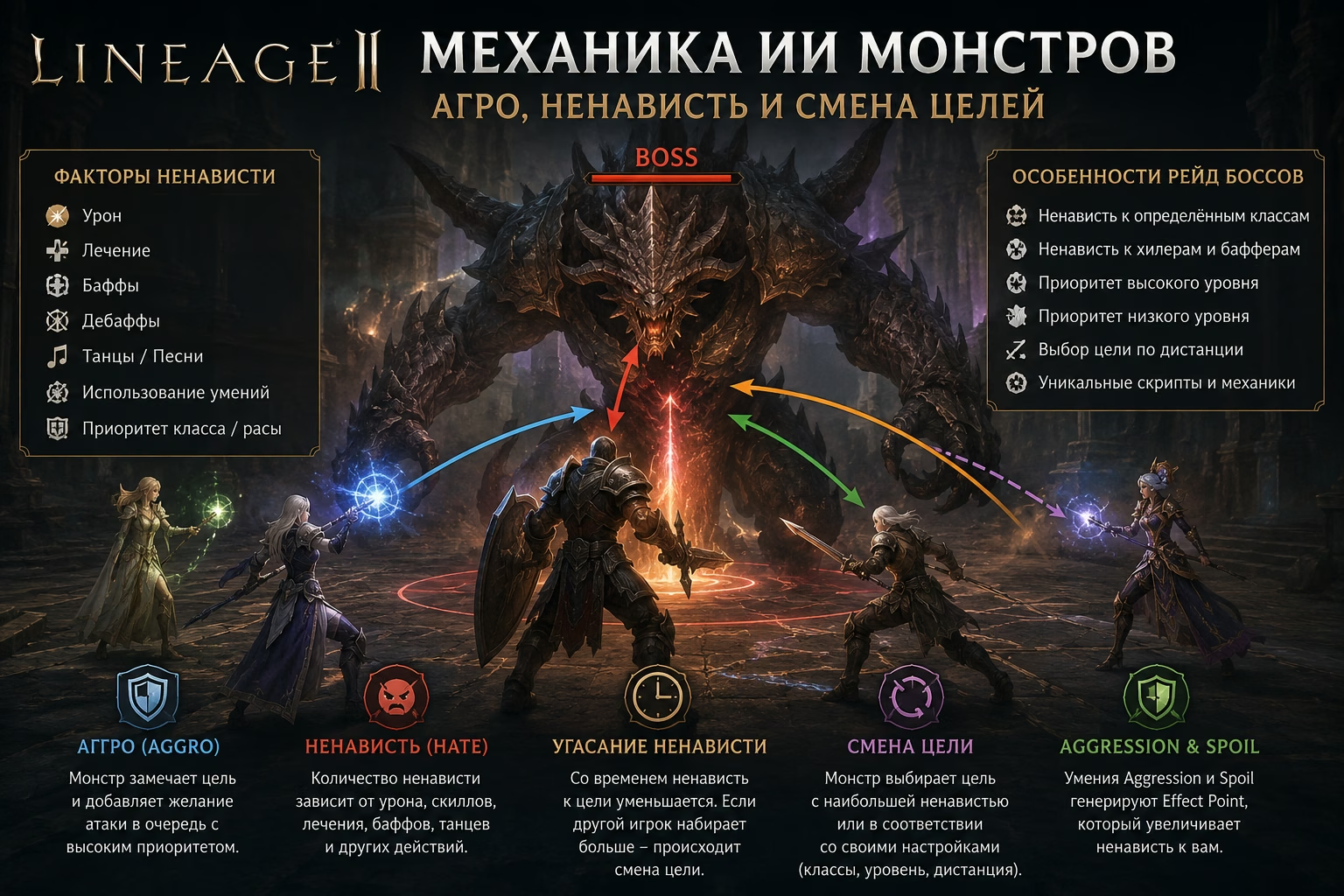
Understanding how monsters choose their targets has always been one of the most mysterious aspects of Lineage 2. By examining official PTS AI scripts, it becomes possible to see exactly how aggression, hate generation, target switching, and raid boss behavior function behind the scenes.
The Monster Life Cycle
Every NPC and monster in Lineage 2 operates using a system known as a "desire queue." When a monster spawns, it immediately receives a set of desires that determine its behavior.
For example, a non-engaged monster may receive a simple desire to wander around its territory. This action has a low priority value, allowing the monster to patrol without interacting with players.
The importance of these values becomes clear when combat begins, as aggression and attacks are handled through the same desire system but with much higher priority levels.
How Aggressive Monsters Detect Targets
Aggressive monsters inherit the standard monster behavior but add a special detection routine. When an aggressive monster sees a player, summon, or another NPC, it does not immediately attack.
On official servers, most aggressive monsters wait approximately seven seconds after spawning before engaging a target. Once this delay has passed and a valid target is detected within the monster's territory, an attack desire is added to the queue with a significantly higher priority than ordinary actions.
Some special monsters bypass this delay entirely and attack the moment they spawn, but these are exceptions rather than the rule.
How Monsters Decide Who to Attack
When a monster is attacked, several factors determine how much hate is generated toward the attacker.
The most important factor is damage dealt. The more damage a player inflicts, the higher their position becomes in the monster's hate list.
However, damage is not the only consideration. Certain monsters are configured to dislike specific groups of classes. Examples include:
Healers
Support classes
Wizards
Melee damage dealers
Specific races
If two players deal similar damage, the monster may prioritize the player belonging to a class group it dislikes more.
This explains why some raid bosses seem to switch targets unexpectedly, especially toward specific classes.
Hate Decay and Target Switching
Hate does not remain permanent.
Every few seconds, the value associated with a monster's desire to attack a particular target gradually decreases. This process is known as hate decay.
As hate values decay, another player's accumulated hate may eventually surpass the current target's value. When this happens, the monster changes targets.
This mechanic is particularly noticeable during raid encounters, where multiple players continuously generate hate through damage and skills.
What Happens When a Monster Cannot Reach Its Target?
A unique mechanic occurs when a monster is unable to reach the player it wants to attack.
Initially, the monster receives a temporary increase in aggression, encouraging it to continue chasing the target. If it still cannot connect with an attack, the hate value eventually begins to decay.
Over time, another player may rise to the top of the hate list, causing the monster to switch targets.
This behavior plays a major role in kiting strategies used against many bosses.
How the Aggression Skill Works
The tank skill "Aggression" does not directly deal damage.
Instead, the skill generates an internal value known as an Effect Point. The monster interprets this value as if it had received damage, even though its HP remains unchanged.
Because the AI treats Aggression as virtual damage, it increases the tank's hate value and makes the monster more likely to focus on them.
Can Spoil Generate Hate?
Surprisingly, yes.
The Spoil skill also contains Effect Point values that contribute to hate generation. While the value is lower than a tank's Aggression skill, repeated use can produce a similar effect.
This is one reason why experienced players occasionally see monsters or bosses react to Spoilers in unexpected ways.
Why Raid Bosses Attack Healers, Buffers, and Dancers
Monsters do not only react to damage. They also react to spell casting.
Whenever a player casts a spell, performs a dance, uses a song, heals an ally, or applies a buff, the AI calculates additional hate based on that skill's Effect Point value.
As a result:
Healers can pull aggro while healing.
Buffers can become targets while supporting the party.
Dancers and Singers can accidentally attract a raid boss's attention.
This explains many situations where support classes suddenly become the boss's primary target despite dealing little or no damage.
Special Raid Boss Behavior
Not all raid bosses behave the same way.
Certain epic bosses, including Baium and Antharas in older chronicles, possessed unique AI settings that prevented some hate values from decaying normally.
Because of this, players developed specialized strategies involving fast-moving mounts and kiting techniques. Once these bosses locked onto a target, they could remain focused on it for extremely long periods.
Later chronicles introduced additional AI customization, including:
Hate toward specific class groups
Hate toward healers and buffers
Hate toward the highest-level player
Hate toward the lowest-level player
Distance-based target selection
These additions made boss encounters significantly more complex than in earlier versions of the game.
PTS vs Java Emulators
According to the analysis of official PTS scripts, monster AI is extraordinarily complex, consisting of hundreds of thousands of lines of behavior logic.
Most Java emulators simplify these systems considerably. While modern emulators may reproduce many features, they generally cannot replicate every detail of the official PTS AI, especially when it comes to advanced hate calculations, class preferences, and specialized raid boss behavior.
Final Thoughts
The Lineage 2 aggression system is far more sophisticated than many players realize. Behind every target switch, aggro reset, and unexpected boss behavior lies a complex network of hate calculations, class modifiers, skill effects, and decay mechanics.
Understanding these systems provides valuable insight into why tanks, healers, damage dealers, and support classes experience combat differently and explains many of the behaviors veteran players have observed throughout Lineage 2's history.