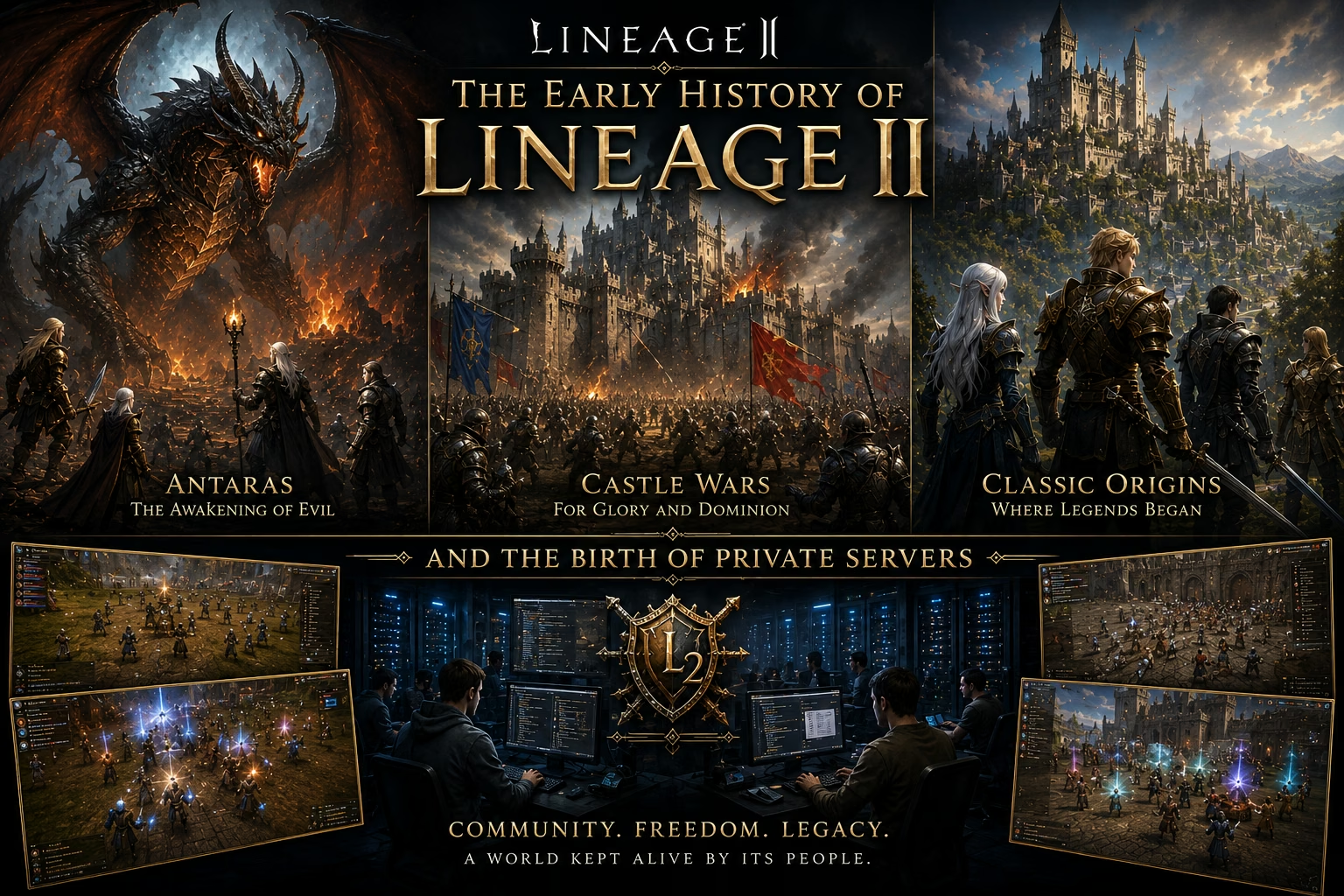
The First Major Update of Lineage II
As discussed in the previous chapter, the developers originally did not intend to launch Lineage II with the Prelude version. However, the desire to release the game before Blizzard pushed NCSoft to launch an unfinished product with limited content.
Only two months later, on January 28, 2004, the first major update, Chronicle 1: Harbingers of War, arrived on Korean servers. This expansion introduced many of the features that would become core elements of Lineage II, including castle sieges, clan halls, new territories, additional weapons and armor, and the first large-scale raid content.
Among the most significant additions was a special quest that granted players access to a battle against the Earth Dragon, Antaras.
The First Antaras Raid
The earliest version of Antaras was very different from the raid boss players know today.
At the time, there were no Epic Jewelry rewards and no Antaras Earring. Instead, defeating Antaras offered a chance to obtain one of the most valuable items in the game: the Staff of Desperion, one of the strongest weapons available during Chronicle 1.
Historical records from Korean servers describe the first Antaras raid as a six-hour battle involving approximately 500 players. Despite the enormous effort, every participant was eventually wiped out by the dragon.
Even so, the rewards were considered worth the risk because Antaras provided the only known source of top-tier equipment upgrades at the time.
Interestingly, many fan databases incorrectly claim that A-Grade equipment did not exist during Chronicle 1. Official developer documentation confirms otherwise, showing that certain A-Grade items were already available through Antaras.
Desperion and the Origins of the Reward
The Staff of Desperion was not chosen randomly as Antaras's reward.
Desperion is one of the most important figures in Lineage II lore. He was responsible for teaching the Dark Elves forbidden dark magic, which explains why Dark Elf mages possess unique abilities unavailable to their Light Elf counterparts.
According to the game's lore, Desperion also played a role in helping seal Antaras within his cave. The connection between the dragon and the staff reflects this important historical relationship.
Raid Bosses Before Raid Bosses Existed
The concept of raid bosses was very different during the earliest days of Lineage II.
Many powerful enemies were simply aggressive monsters with increased health and improved loot tables rather than unique encounters with complex mechanics. This design philosophy bears some resemblance to modern solo raid boss systems, which in some ways represent a return to the game's earliest roots.
A Different World in Chronicle 1
Several iconic locations looked dramatically different during Chronicle 1.
The Blazing Swamp, for example, lacked the volcanic landscape familiar to modern players. There were no rivers of magma or scorched terrain, and even the area's lore would later be rewritten.
Early maps also revealed regions that would not appear in the game until many years later. South and east of Giran, developers had already outlined areas connected to Lake Innadril.
Dialogues from NPC guards referenced islands and the Water Dragon Fafurion long before either appeared in the game. Remarkably, these locations eventually became reality when Fafurion was officially introduced to Korean servers in 2018.
This demonstrates that many elements of Lineage II's world were planned years before players were able to experience them.
The War That Inspired Lineage II Classic
One of the most important events in Lineage II history took place on the Korean server Bartz in 2003.
At the time, two dominant clans, Genesis and Knights of God, united to form the Dragon Knight Alliance. Their control over key hunting grounds and economic resources eventually gave them near-total dominance over the server.
Opposition groups repeatedly failed to challenge their power. Many players left the server after suffering continuous defeats.
Eventually, resistance forces began organizing under various smaller clans. A breakthrough occurred when the Red Revolution clan captured Giran Castle and set taxes to zero percent, inspiring more players to join the anti-monopoly movement.
The growing coalition eventually became known as the Bartz Alliance.
The Liberation War of Bartz
The conflict that followed became one of the most famous player-driven wars in MMORPG history.
Thousands of players joined the struggle against the dominant alliance. Even low-level characters contributed by repeatedly attacking enemy forces, preventing them from recovering health and mana between battles.
The resistance gradually captured multiple castles and eventually targeted Aden Castle, the strongest stronghold controlled by the Dragon Knight Alliance.
In a brilliant strategic move, opposition leaders manipulated siege registrations shortly before the deadline, creating confusion among defenders and securing a numerical advantage during the siege.
After a dramatic battle, the Bartz Alliance captured Aden Castle and ended the Dragon Knight Alliance's rule.
This conflict became known as the Liberation War of Bartz and remains one of the most legendary events in Lineage II history.
Years later, NCSoft directly referenced these events during presentations for Lineage II Classic, confirming that the spirit of the Bartz conflict served as a major inspiration for the Classic project launched in 2014.
The Origins of Private Servers
The early years of Lineage II were also shaped by another development that would have a lasting impact on the community: the creation of private servers.
Because progression in Lineage II required an enormous time investment, many players sought ways to automate gameplay. Developers of the earliest bots began studying the communication between the game client and server.
During this process, they discovered a security vulnerability that allowed access to official server files.
As a result, files from Prelude and Chronicle 1 private test servers were leaked and eventually spread throughout the community. Shortly afterward, the vulnerability was fixed, which explains why authentic Chronicle 2 and Chronicle 3 PTS files never became publicly available.
The Birth of Java Servers
Once server files became available, enthusiast communities began studying how the game worked internally.
Groups such as Post Pacific invested enormous effort into understanding server architecture and eventually launched some of the first functional private servers.
However, modifying official server files proved extremely difficult. This limitation encouraged developers to create alternative server software from scratch.
Using leaked files as reference material, programmers began writing server emulators in Java that replicated the behavior of the original game in a simplified form.
This marked the beginning of the Java server era, which would become a defining part of the Lineage II community for decades.
The End of Chronicle 1
Chronicle 1 remained active for nearly seven months and established many of the systems that would define Lineage II for years to come.
The first Antaras raids, the legendary Bartz Liberation War, the foundations of Lineage II Classic, and the birth of private servers all occurred during this formative period.
While Chronicle 1 laid the groundwork for the game's future, even greater changes were already on the horizon. The next chapter in Lineage II history would introduce new territories, new conflicts, and a new stage in the evolution of one of the most influential MMORPGs ever created.