Introduction
While Lineage II is widely recognized as one of the most influential MMORPGs ever created, many players know surprisingly little about its predecessor. Released in 1998, Lineage 1 laid the foundation for an entire gaming universe and became one of the first massively successful online role-playing games in the world.
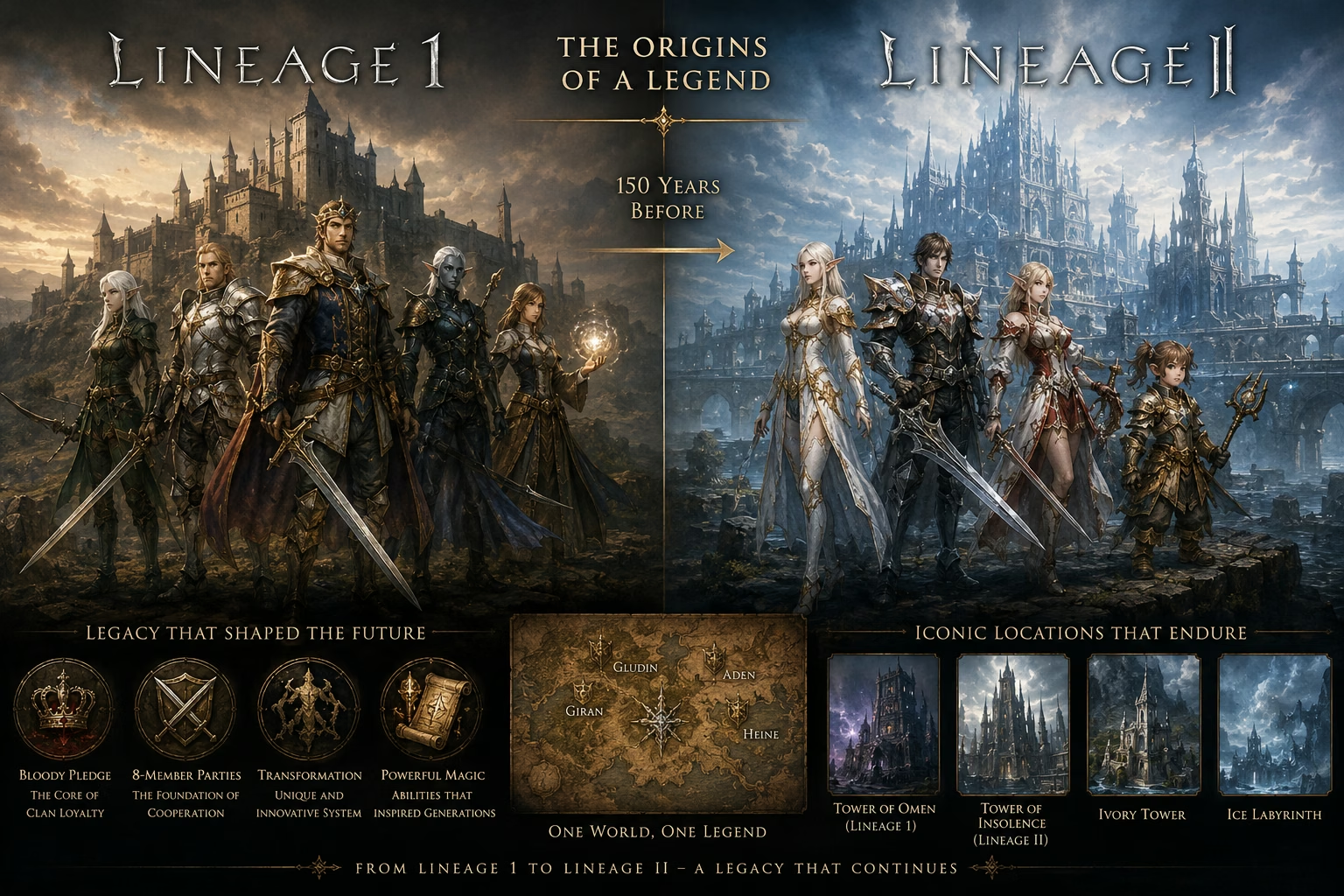
Since Lineage II takes place approximately 150 years before the events of Lineage 1, exploring the original game provides valuable insight into the lore, locations, mechanics, and design philosophies that shaped the franchise.
The Birth of Lineage
Lineage was NCSoft’s first MMORPG and one of the company’s earliest major successes. The first Korean test server opened on July 12, 1998, only a year and a half after NCSoft was founded.
At the time, Ultima Online dominated the MMORPG market. Many of Lineage’s early concepts were inspired by the medieval fantasy world of Ultima, leading some players to consider it a spiritual successor. The connection became even stronger when Richard Garriott, the creator of Ultima, became involved in the project as a producer.
Many interface elements that later appeared in early versions of Lineage II can already be seen in Lineage 1, including inventory layouts, item icons, weapons, armor, and scroll designs.
Classes and Character Progression
Unlike Lineage II, Lineage 1 did not use a profession advancement system. Players selected a class at character creation, and that choice remained permanent throughout the game.
The original version featured classes such as:
Prince
Knight
Elf
Dark Elf
Magician
Dragon Knight
Illusionist
Later versions introduced additional classes, including Warrior, Swordsman, and Spearman-type variants.
Instead of changing professions, players advanced through class-specific quests at levels 15, 30, 45, and 50. These quests rewarded unique skills, equipment, and special class abilities.
Interestingly, races familiar to Lineage II players, such as Orcs and Dwarves, were not playable. However, Orc tribes and members of the Iron Gate Guild existed within the game world as NPCs and monsters.
Party and Clan Systems
Parties in Lineage 1 consisted of eight players rather than nine. Historical information later revealed that early Korean beta versions of Lineage II also used an eight-player party system, highlighting the strong design continuity between the two games.
One of Lineage 1’s most distinctive features was its clan structure. Only the Prince class could create a clan, and joining required a direct interaction with the clan leader through the famous “Bloody Pledge” system.
This mechanic transformed clans into something more meaningful than ordinary guilds. Members were expected to demonstrate loyalty to their leader, creating social structures that resembled medieval kingdoms rather than simple player organizations.
This philosophy carried over into Lineage II, where clan leaders, trusted officers, and ordinary members formed complex social hierarchies. Castle ownership, political alliances, betrayals, and clan rivalries became central elements of gameplay.
Unique Gameplay Features
Transformations
Lineage 1 featured a transformation system that allowed players to become various creatures and monsters.
Transformations could alter how NPCs and monsters reacted to a character. Some enemies ignored transformed players, while others treated them as members of their own species.
One of the most famous transformations was the Death Knight, a concept that later inspired content within Lineage II.
Magic System
Many spells in Lineage 1 had unique mechanics that never appeared in Lineage II.
Examples included:
Blindness, which restricted a player’s field of vision.
Silence, which prevented both spellcasting and chat communication.
Necromantic abilities that allowed undead creatures to be controlled or manipulated.
Several iconic Lineage II skills and effects originated from these early mechanics.
The World of Lineage
Many locations from Lineage II have roots in Lineage 1.
Players can find familiar settlements such as:
Gludin
Giran
Aden
Heine
However, some cities either did not yet exist or appeared under different names.
For example, Windawood was already present and featured its own castle. In Lineage II, the same area appears as the Windawood Manor, suggesting its growth over the course of 150 years.
The demon Beleth also appears in both games, although his role and appearance differ significantly.
Lineage, Manhwa, and Legal Disputes
The original Lineage was based on the Korean fantasy manhwa created by Shin Il-suk.
Initially, the relationship between the comic and the game benefited both sides. The manhwa expanded the game’s story, while the game introduced new readers to the comic.
As Lineage’s popularity exploded, disagreements emerged regarding ownership and intellectual property rights. In 2001, legal disputes arose between the creator of the manhwa and NCSoft.
Although the game continued operating, the conflict encouraged NCSoft to gradually establish its own independent setting known as the “Aden World.” This allowed future titles, including Lineage II, to develop their own lore while remaining inspired by the original universe.
The Tower of Insolence and the Story of Beleth
One of the most fascinating connections between the games involves the Tower of Insolence.
In Lineage 1, the structure is known as the Tower of Omen. According to the story, an ambitious king sought immortality and was manipulated by the magician Beleth.
Beleth convinced the king that he could achieve eternal life by reaching and defeating the God of Death. To accomplish this, a massive tower was constructed using dark magic.
Countless workers died during its construction. When the tower was finally completed, a dark portal appeared and consumed the entire structure.
The God of Death cursed everyone present. The king received immortality, but at a terrible price—he was transformed into a monstrous being and trapped within the tower forever.
Although the versions of the Tower of Insolence found in Lineage 1 and Lineage II are not identical, the core themes and concepts clearly share the same origins.
The Ivory Tower
The Ivory Tower also appears in both games, though in different forms.
In Lineage 1, the tower serves as a magical institution with dedicated floors for various purposes:
Elven studies
Human magic instruction
Elder chambers
Magical experiments
Containment of dangerous creatures
Interestingly, early versions of Lineage II contained evidence that its Ivory Tower was originally designed with a similar multi-floor structure, suggesting that the developers initially planned a much closer adaptation of the original concept.
The Frozen North and the Crystal Cave
Near the snowy city associated with the Ivory Tower lies the domain of the Snow Queen.
Legends speak of a mysterious Crystal Cave connected to a frozen lake. Travelers believed the cave functioned as a labyrinth, where only those who reached the lake could escape.
This concept later inspired the Ice Labyrinth found in Lineage II.
According to the lore, the region’s harsh climate exists because the Snow Queen opposed the immense heat generated by the dragon Valakas, creating a unique balance between fire and ice.
Conclusion
Lineage 1 was far more than a predecessor to Lineage II. It introduced many of the mechanics, locations, social systems, and lore concepts that would later define the franchise.
From the Bloody Pledge clan system and transformative magic to the origins of iconic locations such as the Ivory Tower and the Tower of Insolence, the original game remains an essential piece of Lineage history.
For players interested in understanding the deeper roots of the Lineage universe, exploring the world of Lineage 1 reveals just how much of the franchise’s identity was established from the very beginning.