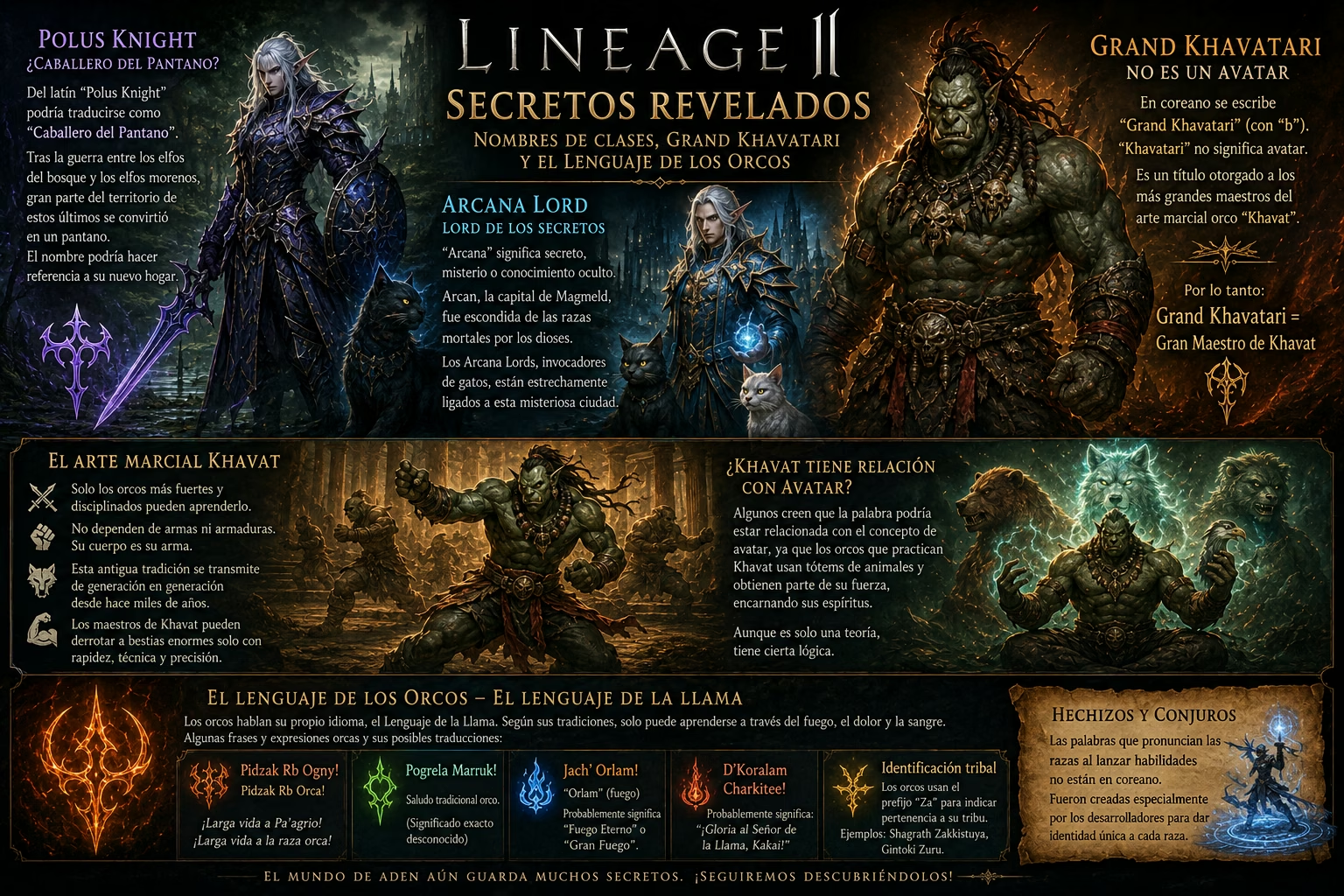
Lineage II is filled with names, titles, and languages that often hide deeper meanings than players realize. While many class names appear straightforward at first glance, a closer examination of the game's lore, quests, and original Korean terminology reveals fascinating connections to history, mythology, and race-specific traditions.
This article explores the possible origins of the Polus Knight and Arcana Lord professions, uncovers the true meaning behind the title Grand Khavatari, and takes a closer look at the mysterious Language of Flame spoken by Orcs throughout the world of Aden.
The Mystery of Polus Knight
One of the most debated profession names in Lineage II is Polus Knight, the first-class advancement of the Dark Avenger line.
At first glance, some players have suggested a connection to the word "Paladin," derived from the Latin palatinus, meaning a palace or court knight. However, this theory has several weaknesses. Aside from sharing a few similar letters, the two classes represent completely different ideals. Paladins serve the Goddess of Light, while Dark Knights are closely tied to darkness and death.
A more intriguing possibility comes from examining the name through Latin roots. Under this interpretation, "Polus Knight" may be translated as "Swamp Knight."
This theory aligns surprisingly well with Dark Elf history. Following the war between the Forest Elves and Brown Elves, much of the Brown Elf homeland was transformed into a vast swamp. The profession name may therefore reference the environment in which the Dark Elves ultimately settled.
Although the exact origin remains uncertain, the connection to the Dark Elf homeland offers one of the most compelling explanations.
Arcana Lord and the Hidden City of Arcan
Another profession whose name may carry a deeper meaning is Arcana Lord.
The word arcana can be translated as "secret," "mystery," or "hidden knowledge." As a result, Arcana Lord could be interpreted as "Lord of Mysteries" or "Master of Secrets."
This interpretation becomes especially interesting when considering Arcan, the capital city of the Magmeld region. According to the game's lore, Arcan was hidden from the mortal races by the gods themselves.
Since Arcana Lords specialize in summoning feline companions and Arcan is closely associated with cats, there may be a deliberate connection between the profession and the city.
While no official confirmation exists, the linguistic and thematic similarities make this theory highly plausible.
Hawk Eye Was Always a Profession
While examining profession names, another interesting discovery emerges.
The Korean version of the Human Archer profession uses a direct transliteration of Hawk Eye, matching the English version almost exactly.
This suggests that Hawk Eye was never intended to be a nickname or title. It was always the official profession name from the beginning.
Grand Khavatari: More Than an Avatar
Perhaps the most misunderstood profession title in Lineage II is Grand Khavatari.
Many players assume that the title simply refers to an Avatar, the famous Orc class. However, the original Korean terminology tells a different story.
According to Korean sources, the profession is written as Grand Khavatari, not Grand Avatar. Korean already contains a separate term used to describe an avatar or spiritual incarnation, making it unlikely that the name was intended to mean the same thing.
The word "Grand" appears to have been added primarily for emphasis and prestige. The real mystery lies in the term Khavatari itself.
The Origins of Khavat
The answer can be found in Orc quest texts.
During the Monk class quest, players learn about Khavat, a traditional Orc martial art practiced only by the strongest and most disciplined warriors.
Unlike conventional fighters, Khavat practitioners reject dependence on armor and weapons. Instead, they train their own bodies to become instruments of combat.
For thousands of years, Khavat has been passed down through Orc generations as one of their most respected traditions. Masters of the art are said to defeat powerful beasts using only speed, technique, and precise strikes.
Khavatari Is a Title
The English quest dialogue provides an important clue.
Throughout the Orc class quests, the word Khavatari is not used as a profession name but as a title granted to the greatest masters of Khavat martial arts.
Characters address one another using the title, indicating that it represents rank and achievement rather than a class itself.
This means that Grand Khavatari is more accurately translated as something like:
"Great Master of Khavat"
or
"Supreme Khavatari."
Rather than being another word for Avatar, it is a prestigious title earned through mastery of traditional Orc combat.
Is Khavat Connected to Avatar?
Some lore researchers have suggested a possible connection between the words Khavat and Avatar.
The theory is based on similarities in spelling and the fact that Khavat practitioners draw strength from animal totems. Through these totems, Orc warriors temporarily embody aspects of powerful beasts, effectively becoming vessels for their spirits.
In that sense, the martial art shares conceptual similarities with the idea of an avatar or spiritual incarnation.
While this connection remains speculative, it offers an interesting perspective on the origins of Orc traditions.
The Orc Language: The Language of Flame
Orcs possess their own unique language known as the Language of Flame.
According to Orc traditions, this language can only be learned through fire, pain, and blood. It serves not only as a means of communication but also as a cultural symbol connecting Orcs to their ancestors and totem spirits.
Many Orc skills, rituals, and titles preserve fragments of this ancient language.
Translating Orc Expressions
Several Orc phrases appear throughout quests and dialogue.
Pidzak Rb Ogny / Pidzak Rb Orca
These expressions frequently appear in the Titan Saga questline.
Based on contextual clues, they likely mean:
"Long live Pa'agrio!"
"Long live the Orc race!"
Pogrela Marruk
Another common greeting spoken by Orc spirits and NPCs.
Its exact meaning remains unknown, but it is clearly used as a form of respectful greeting.
Jach Orlam
Appearing during the Shaman class quests, this phrase is believed to mean:
"Eternal Flame" or "Great Flame."
The root lam consistently appears in phrases associated with fire.
D'Koralam Charkitee
This expression appears in several Orc questlines.
Analysis of the surrounding dialogue suggests it translates roughly as:
"Praise to the Lord of Flame, Kakai."
Tribal Identification
Orcs often identify their tribe using the prefix Za.
Examples include:
Shagrath Zakkistuya
Gintoki Zuru
This appears to function as a linguistic marker indicating tribal affiliation.
The Secret Behind Spell Incantations
Many players have wondered whether the words spoken by characters while casting skills belong to Korean.
According to translators familiar with the game's files, they do not.
Just like the Orc Language of Flame, the casting phrases used by various races were specially invented by the developers to give each race its own unique identity and culture.
These fantasy languages were designed specifically for the world of Lineage II and are not directly based on Korean or any real-world language.
Conclusion
Lineage II's class names and languages contain far more depth than most players ever notice.
From the possible "Swamp Knight" origins of Polus Knight to the hidden connection between Arcana Lord and the city of Arcan, the game is filled with subtle lore references. The title Grand Khavatari turns out not to be another word for Avatar, but a prestigious rank awarded to masters of the ancient Orc martial art known as Khavat.
Meanwhile, the Language of Flame continues to add mystery and cultural depth to the Orc race, preserving fragments of a fictional language that remains one of the most fascinating aspects of Lineage II lore.
Even after all these years, the world of Aden still holds countless secrets waiting to be uncovered.