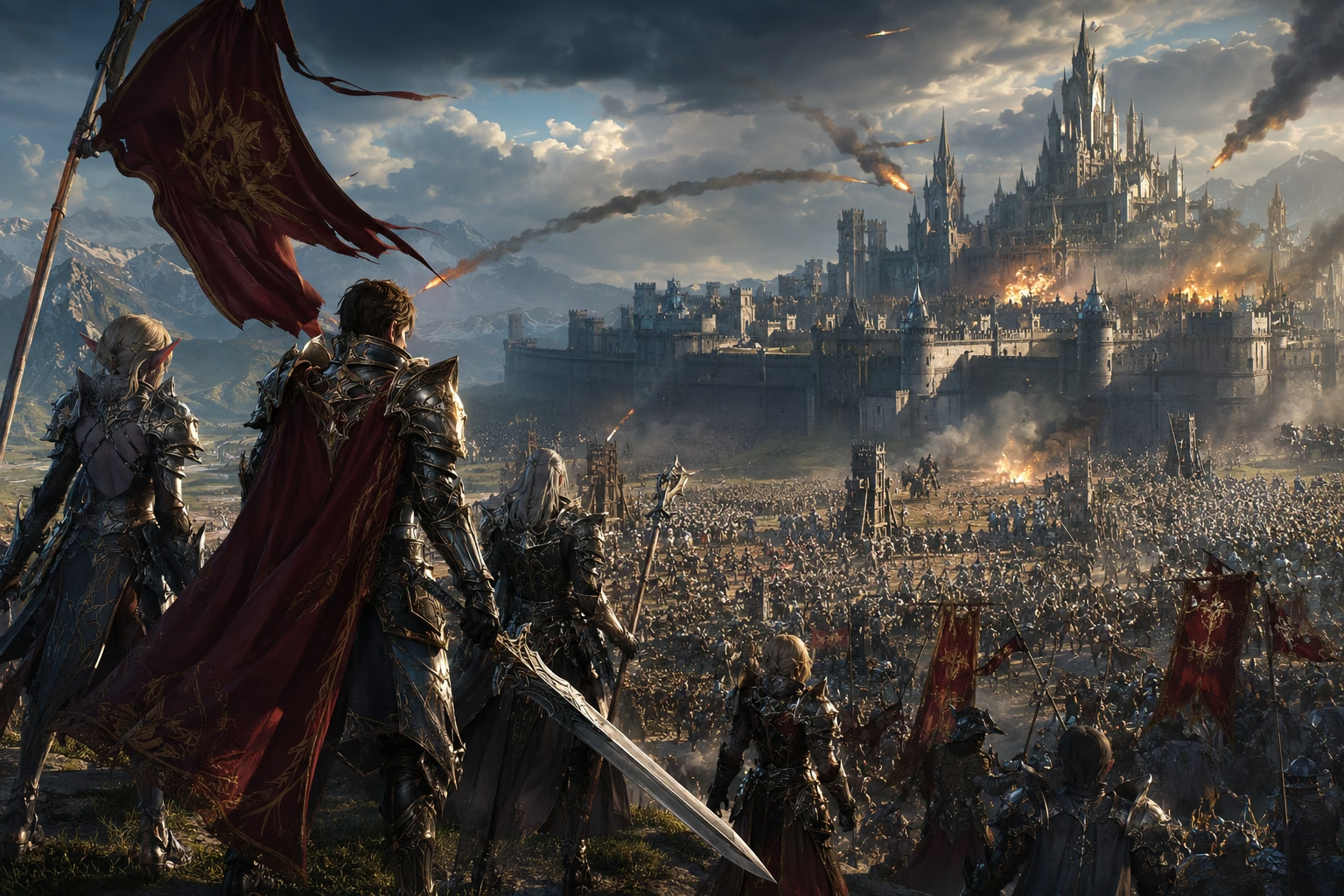
November 30, 2002, marked a historic moment for MMORPG fans. On that day, NCSoft launched the first phase of the Lineage 2 Closed Beta Test in South Korea, beginning the journey of what would become one of the most influential online role-playing games ever created.
To understand how Lineage 2 came to life, it is important to look back at the evolution of the Korean gaming industry, the success of Lineage 1, and the vision of the developers who helped shape the MMORPG genre.
The Birth of Korean Online RPGs
The roots of Korean online gaming can be traced back to the late 1980s and early 1990s with text-based multiplayer games known as MUDs (Multi-User Dungeons). Inspired by similar games from the West, Korean developers began creating localized versions that supported the Korean language.
One of the earliest examples was a Korean adaptation of a MUD developed in 1994. Among the developers involved was Jake Song, a name that would later become synonymous with some of Korea’s most successful MMORPGs.
Shortly afterward, games such as The Land of Dahn and Kingdom of the Winds appeared. Released in 1996 by Nexon, Kingdom of the Winds became one of the first successful Korean MMORPGs and remains one of the longest-running online games in the world.
These early titles often drew inspiration from Korean mythology and culture, helping establish a unique identity for the Korean gaming market.
Jake Song and the Creation of Lineage
Following the success of Kingdom of the Winds, Jake Song joined NCSoft and began developing a new MMORPG based on the popular Korean comic series Lineage.
Released in 1998, Lineage introduced several innovations that would later influence Lineage 2, including:
Large-scale clan systems
Castle sieges
Clan-based warfare
Open-world PvP
A strong focus on community and leadership
Unlike many MMORPGs of its era, Lineage emphasized loyalty to clans and their leaders rather than simply providing players with tools for organization. This philosophy became one of the defining features of the franchise.
Legal Challenges and the Birth of the Aden World
As Lineage grew in popularity, legal disputes emerged regarding the rights to the original comic series.
Although the game was initially based on the comic’s universe, NCSoft eventually decided to develop its own independent setting known as the Aden World. This move allowed the company to avoid future copyright conflicts and gave the developers complete creative freedom.
This decision also explains why Lineage 2 has relatively few direct connections to the original comic and why much of its lore evolved independently.
The Beginning of Lineage 2 Development
Development of Lineage 2 officially began in October 2000 under the internal project name Project L2.
The development team had two primary goals:
Create a fully 3D MMORPG.
Build gameplay around large-scale castle sieges and clan warfare.
To accelerate development, NCSoft licensed Unreal Engine 2, which was an uncommon decision at the time. Many studios still relied on proprietary engines, making NCSoft one of the early adopters of licensed game technology.
Competition with Blizzard
During development, NCSoft learned that Blizzard was working on its own MMORPG project, later revealed as World of Warcraft.
Concerned about direct competition, NCSoft accelerated the development schedule in an effort to release Lineage 2 before Blizzard’s title entered the market.
While this strategy helped the game launch earlier, developers later admitted that it forced them to cut significant content, including quests, systems, and planned features.
Years later, some developers summarized the decision with a simple observation:
NCSoft conquered Korea but lost the rest of the world.
Early Demonstrations and Alpha Versions
The first public presentation of Lineage 2 took place on March 14, 2002.
Early screenshots and demonstration videos revealed a game that differed significantly from the final release:
Larger city layouts
Different castle designs
More expansive environments
Character capes that were later removed
Alternative character models
Dynamic day and night cycles
Additional monsters and equipment
Several features shown during development never made it into the final game due to technical limitations or gameplay concerns.
Features That Were Removed
One of the most fascinating discoveries from early footage is that Dark Elves originally possessed summoning abilities similar to those later used by Necromancers.
Developers also experimented with advanced archery mechanics, including:
First-person aiming
Arrow-tracking cameras
Enhanced projectile physics
Although these ideas were innovative, technical limitations and performance concerns led to their removal.
Other planned features included:
Strider mounts for players
Expanded castle systems
More detailed trading mechanics
Larger versions of existing cities
Many of these concepts would either be abandoned or significantly redesigned before launch.
The First Closed Beta Test
The first Korean Closed Beta Test began on November 30, 2002.
Interest was enormous. More than 142,000 applications were submitted, yet only 400 players were selected for the initial testing phase.
The earliest version of the game featured only a limited portion of the world, including:
Talking Island
Parts of Gludio Territory
Basic hunting zones
Many iconic locations such as Dion, Giran, and Oren were not yet available.
Castle sieges were also tested during the beta period, though they suffered from severe performance issues. To improve stability, developers eventually reduced the polygon count of character models and continued optimizing the game engine.
Open Beta and Rapid Expansion
When Open Beta Testing began, player demand exceeded all expectations.
NCSoft continuously opened new servers to accommodate the growing population. Within just a few months, the company expanded to dozens of servers as hundreds of thousands of players joined the game.
By the end of 2003:
Lineage 2 had nearly 900,000 paying subscribers.
The game was named Korea’s Best Game of 2003.
The development team received a prestigious Presidential Award.
A Landmark MMORPG
More than two decades later, Lineage 2 remains one of the most influential MMORPGs ever created. Its focus on clan warfare, castle sieges, open-world competition, and player-driven communities helped define an entire generation of online games.
From humble beginnings in Korea’s early online gaming scene to becoming a global phenomenon, the story of Lineage 2 is not just the history of a game—it is the history of MMORPG development itself.